



Operational continuity in operating rooms and ICUs has become an essential criterion for hospitals that need to reduce critical interruptions, improve patient safety and optimize the work of clinical teams. In critical areas, incorporating advanced technology is not enough: real value appears when integrated hospital equipment organizes the space, centralizes functions, facilitates access to medical gases, electricity and data, and supports the real workflow of healthcare professionals.
In operating rooms, intensive care units, recovery rooms and high-dependency environments, an interruption can originate from multiple factors: poorly positioned equipment, cables in circulation areas, insufficient outlets, fragmented interfaces, lack of accessibility, poor ergonomics or difficulty monitoring technical parameters. For this reason, designing critical areas requires a global vision that connects clinical architecture, technical panels, ceiling supply units, control software and life-cycle maintenance.
In critical areas, operational continuity does not depend on a single system: it depends on how architecture, equipment, technology and clinical workflow are integrated.
This approach expands the line developed by Tedisel Medical in the article on digital architecture of the connected operating room, which analyzes how HERMES, technical panels and supply units work as part of a connected surgical ecosystem. In this new content, the focus shifts toward operational continuity: how this integration reduces interruptions, improves accessibility and enables a more fluid clinical response.
What operational continuity in operating rooms and ICUs means
Operational continuity in operating rooms and ICUs is the ability to maintain clinical activity without avoidable interruptions. It is not limited to electrical availability or the correct operation of a device. It includes how the care space is designed, how technical services are distributed and how the medical team interacts with technology during a procedure or intensive care activity.
An ICU or operating room with strong operational continuity allows professionals to quickly access critical supplies, visualize relevant information, reorganize devices easily, reduce physical obstacles and keep their attention focused on the patient. This concept is also linked to the management of the physical healthcare environment, an area in which organizations such as The Joint Commission highlight the importance of reducing risks associated with the environment where healthcare is delivered.
In practice, this continuity depends on a combination of factors:
- architectural planning of the critical area;
- integration of medical gases, electricity and data;
- centralization of controls and visualization;
- ergonomics for healthcare professionals;
- safe mobility around the patient;
- cleaning and infection control;
- accessibility for maintenance;
- adaptability to different procedures.
Integrated hospital equipment: the foundation of efficient critical areas
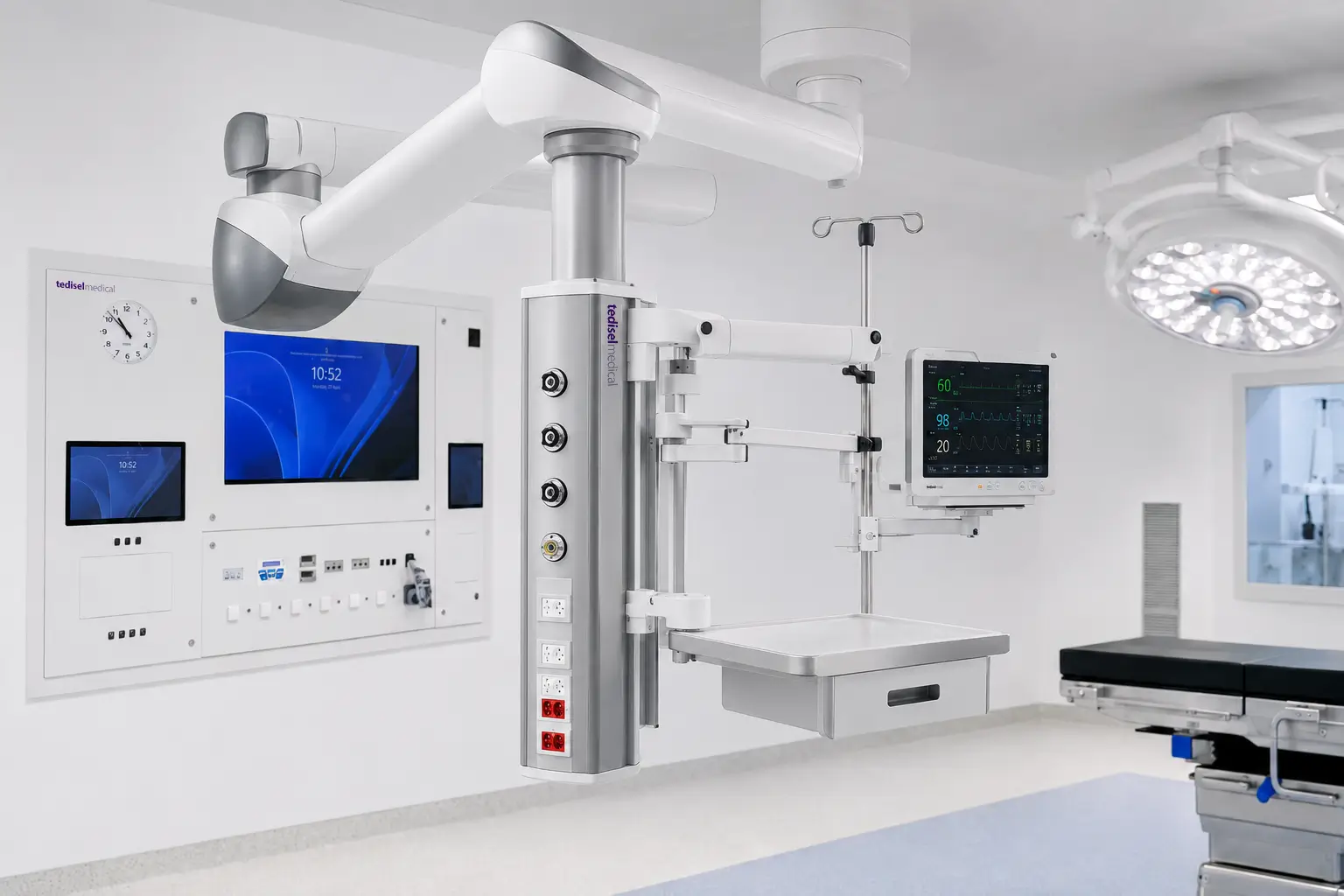
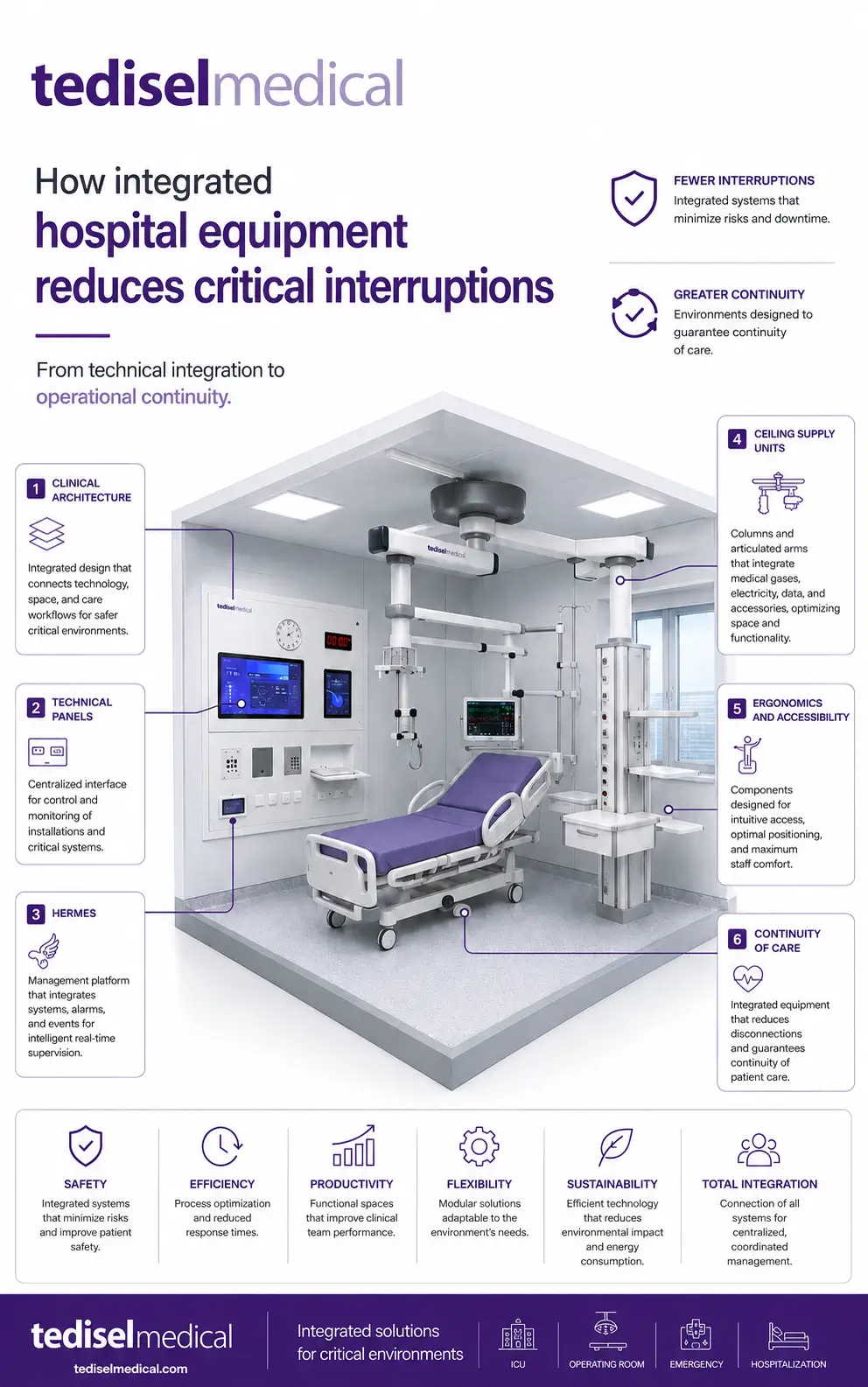
Integrated hospital equipment acts as a functional infrastructure that organizes the space and reduces friction during clinical activity. Its value is not only in supporting devices, but in bringing technical services closer to the point of care and ensuring that medical gases, electricity, data, monitors, trays, articulated arms and accessories are available where the healthcare team needs them.
This approach is directly related to ceiling supply units in operating rooms and ICUs, a family of solutions that makes it possible to organize critical supplies through a suspended, ergonomic and adaptable architecture. By freeing up floor space and reducing scattered elements, these units help create safer, more hygienic and more efficient environments.
Integrated hospital equipment not only improves spatial order: it reduces micro-interruptions that affect clinical workflow during a procedure or critical care activity.
At Tedisel Medical, this vision is materialized through solutions such as Motorized Column, Non-Motorized Column, S-Column, Abitus, Ares, Atlas and Tor. Each system makes it possible to configure the environment according to the clinical area, the level of care complexity and the needs of the medical team.
Technical panels: centralized control to reduce interruptions
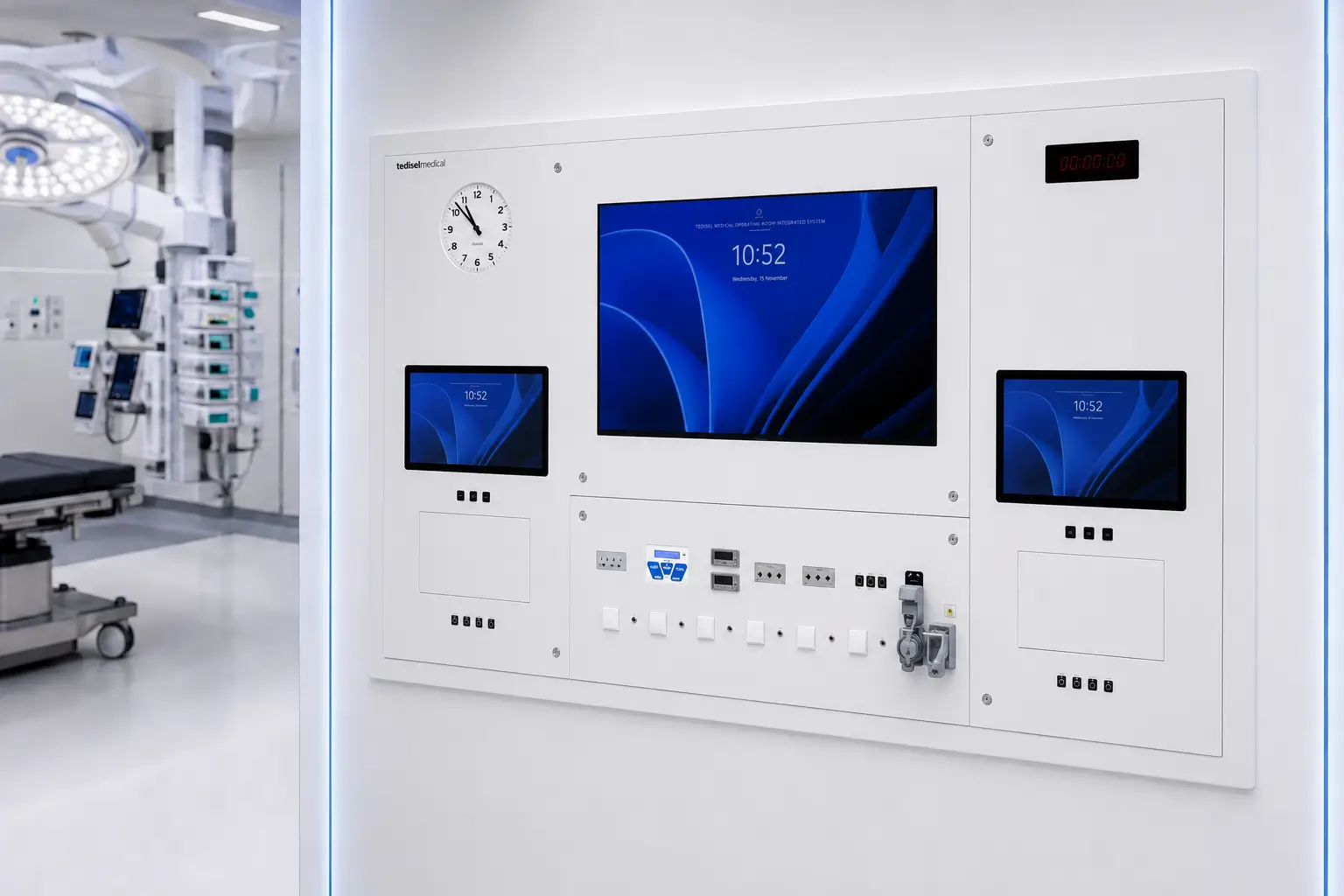
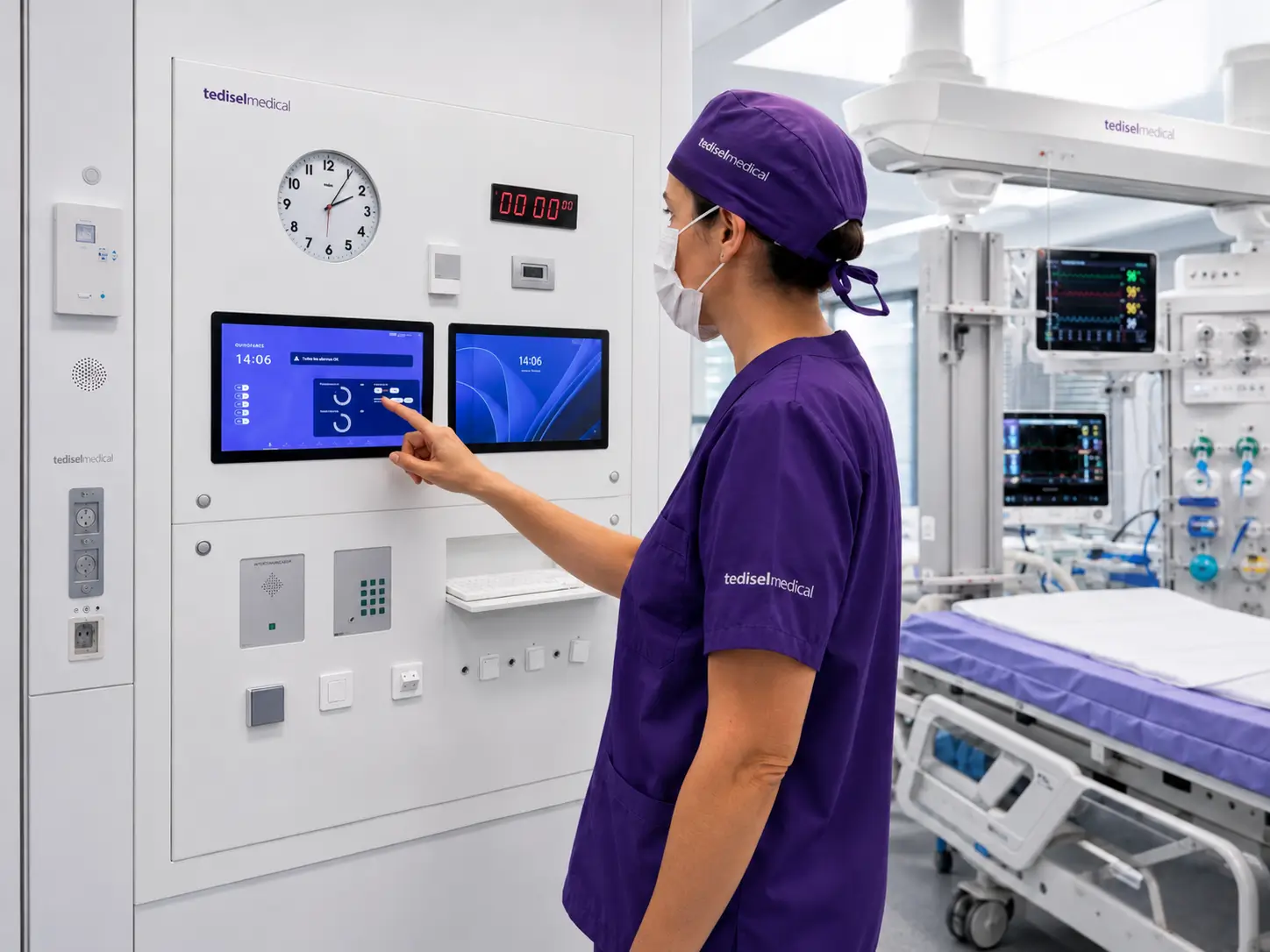
Technical panels are a key element for operational continuity in operating rooms and critical areas. Solutions such as Q Panel and Glass Panel make it possible to centralize visualization, controls, screens, clocks, communication, alarms, accessories and technical elements in an integrated and easy-to-clean surface.
This approach reinforces the content published by Tedisel Medical on operating room technical panels, where it explains how these systems improve control, integration and clinical safety. In a surgical environment, having a centralized interface reduces unnecessary movements, facilitates supervision and prevents information from being fragmented across multiple points in the room.
Technical panels contribute to operational continuity because they make it possible to:
- concentrate relevant information in a visible point;
- integrate touchscreens or display screens;
- facilitate access to environmental controls;
- reduce scattered elements in the operating room;
- improve cleaning through continuous surfaces;
- facilitate maintenance and technical access;
- adapt to different surgical configurations.
In particular, Q Panel is designed to centralize the controls, elements and visual resources required in the operating room, while Glass Panel provides a glass display solution compatible with PACS, nurse stations and control software.
HERMES: control software for a more coordinated operating room
Operational continuity in operating rooms and ICUs also depends on the ability to centralize data, controls and events in the clinical environment. At this point, HERMES functions as a digital layer that makes it possible to manage controls and obtain data from the operating room or critical area through an integrated interface.
HERMES should not be understood as an isolated element, but as part of a broader clinical architecture. Its value increases when it is integrated with technical panels, audiovisual systems, environmental controls and hospital equipment located around the patient. In this way, the connected operating room ceases to be a sum of independent devices and becomes a coordinated environment.
Operating room digitalization only delivers real value when it is connected to the physical space, technical panels and healthcare team workflows.
This approach is aligned with the international trend toward care environments where control of physical space, ventilation, humidity, temperature, lighting and support systems must be considered from an integrated perspective. ASHRAE, for example, highlights that environmental conditions in operating rooms must be treated as design and operation requirements to support safety, comfort and surgical-area performance.
Modern ICU: continuity of care, ergonomics and rapid response
Operational continuity does not end in the surgical block. In the ICU, integrated equipment is decisive because care is continuous, intensive and dependent on multiple devices. Monitors, ventilators, infusion pumps, medical gases, data, supports, trays, lighting and nurse-call systems must operate within a clear, accessible and safe environment.
The Tedisel Medical article on ICU hospital design already highlighted the importance of combining technology, ergonomics, integrated equipment and clinical efficiency. This new approach reinforces that line from the perspective of continuity of care.
An ICU designed to reduce interruptions must facilitate:
- rapid access to medical gases and electricity;
- organization of monitors and infusion pumps;
- mobility around the bed;
- reduction of cables and obstacles;
- adaptability to different levels of complexity;
- efficient cleaning and accessible surfaces;
- rapid response to clinical changes.
International ICU design guidelines stress that intensive care units are part of a critical-care environment and require specific functional planning, where space, equipment, flows and clinical support must be coordinated from the project stage.
How to reduce critical interruptions through equipment design
Reducing critical interruptions does not depend only on internal protocols. It also depends on design decisions made from the early stages of the hospital project. When architecture, engineering and clinical management work with an integrated vision, equipment stops occupying the space reactively and becomes part of an operational strategy.
These are some key actions to improve operational continuity in operating rooms and ICUs:
1. Analyze the real clinical workflow
Before defining the location of panels, columns, arms or accessories, it is necessary to study how the healthcare team moves, which procedures are performed, which devices are used most frequently and which areas must remain clear.
2. Bring technical services closer to the point of care
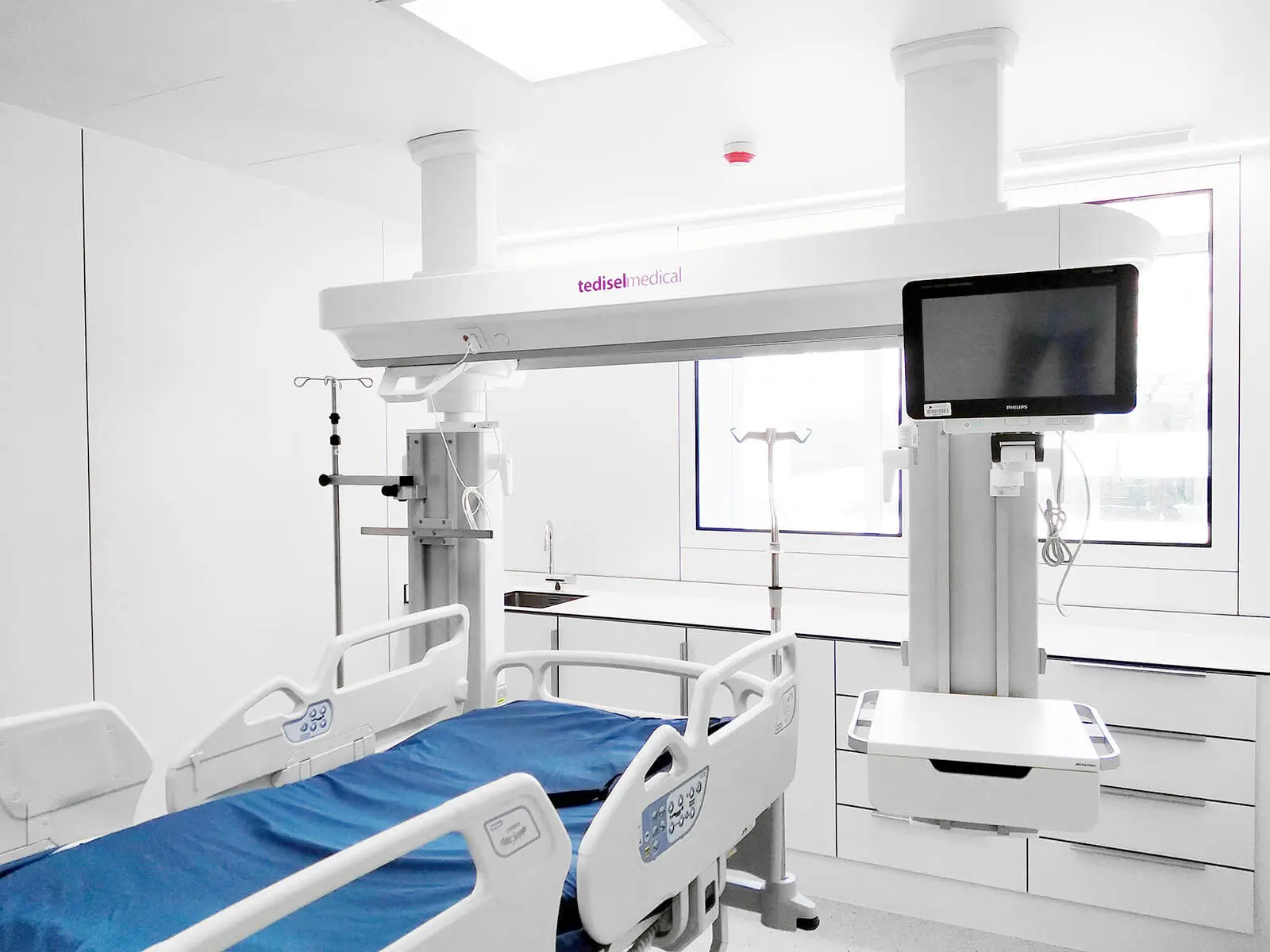
Ceiling supply units make it possible to position medical gases, electricity, data, supports and accessories close to the patient without blocking the workspace. This criterion is especially relevant in ICUs, anesthesia areas, operating rooms and recovery areas.
3. Centralize controls and visualization
Technical panels and HERMES help reduce fragmented interfaces. This centralization allows the healthcare team to access key information and functions from defined points, improving coordination and response times.
4. Design for cleaning and maintenance
Operational continuity also depends on how easy it is to clean, inspect and maintain the equipment. This approach connects with Tedisel Medical’s content on hospital maintenance, efficiency, safety and sustainability, where maintenance is presented as part of the hospital life cycle.
5. Plan technological scalability
Critical areas evolve. New procedures, new technologies and new clinical needs require modular and configurable solutions. That is why adaptability must be a design criterion, not a later correction.
Operational continuity and patient safety
Patient safety does not depend only on the clinical act. It also depends on the environment where that act takes place. An operating room with scattered controls, poorly positioned accessories or inaccessible systems can generate micro-interruptions that alter the pace of work. By contrast, an integrated environment facilitates concentration, reduces cognitive load and improves response to critical situations.
Operational continuity contributes to patient safety because it:
- reduces physical interference during critical procedures;
- improves access to supplies and devices;
- facilitates supervision of the clinical environment;
- supports a faster team response;
- reduces visual and physical clutter;
- improves coordination between professionals;
- supports traceability and technical control.
From this perspective, integrated hospital equipment is not an aesthetic or functional accessory. It is a strategic tool to improve the performance of the critical area and the safety of care.
Difference between electrical continuity and operational continuity
It is important to distinguish between electrical continuity and operational continuity. Electrical continuity focuses on maintaining supply, supervising critical electrical systems and preventing failures related to the hospital’s energy infrastructure. Operational continuity, on the other hand, has a broader focus: it analyzes how equipment organization, ergonomics, technical panels, supply units, clinical architecture and control software make it possible to maintain care activity without avoidable interruptions.
Both dimensions are complementary. However, in the case of Tedisel Medical, the differential value lies in the design and manufacture of integrated hospital equipment for operating rooms, ICUs and critical areas. This positioning makes it possible to differentiate Tedisel’s specialization within the hospital ecosystem and reinforce its technical authority in equipment, integration and clinical architecture.
Tedisel Medical: integrated solutions for critical areas
Tedisel Medical develops solutions for hospitalization, critical areas and the surgical block from an integrated vision of the clinical space. Its catalog makes it possible to configure environments adapted to different levels of care complexity through technical panels, control software, ceiling supply units, columns, articulated arms and bed head units.
Within the surgical block and critical areas, key solutions include Q Panel, Glass Panel, HERMES, Motorized Column, Non-Motorized Column, S-Column, Abitus, Ares, Atlas and Tor.
The future of critical areas will not depend only on adding more technology, but on integrating it better to guarantee safety, efficiency and continuity of care.
Conclusion: designing critical areas from operational continuity
Operational continuity in operating rooms and ICUs must be understood as a hospital design criterion. A well-planned critical area allows professionals to work without obstacles, ensures that technical services are available at the right point, integrates technology without generating complexity and enables maintenance to be carried out quickly and safely.
In this context, Tedisel Medical provides specialized expertise in integrated hospital equipment, combining technical panels, HERMES software, ceiling supply units and configurable solutions for operating rooms, ICUs and critical areas. Technical integration thus becomes a tool to reduce critical interruptions, improve clinical efficiency and reinforce patient safety.
Frequently asked questions about operational continuity in operating rooms and ICUs
What is operational continuity in operating rooms and ICUs?
Operational continuity in operating rooms and ICUs is the ability to maintain clinical activity without avoidable interruptions thanks to the correct integration of hospital equipment, medical gases, electricity, data, technical panels, control software and ergonomic design.
Why is integrated hospital equipment important in critical areas?
Integrated hospital equipment makes it possible to organize critical services, reduce obstacles, improve ergonomics for healthcare professionals and facilitate a faster response during surgical procedures or intensive care activities.
What role do technical panels play in operational continuity?
Technical panels centralize controls, visualization, communication and systems in the surgical environment. This reduces movements, improves coordination and facilitates operating room management from an integrated point.
How does HERMES help improve operational continuity?
HERMES makes it possible to centralize controls and data from the operating room or critical area, integrating with technical panels such as Q Panel or Glass Panel. Its role is to enable more coordinated management of the clinical environment.
What do ceiling supply units provide in operating rooms and ICUs?
Ceiling supply units bring medical gases, electricity, data, devices and accessories closer to the point of care. They also free up floor space, reduce obstacles and improve ergonomics for healthcare professionals.
Are operational continuity and predictive maintenance the same?
No. Predictive maintenance focuses on anticipating technical failures through data and monitoring. Operational continuity is a broader concept, related to integrated clinical-environment design, ergonomics, equipment access, spatial organization and the ability to maintain care activity without avoidable interruptions.